
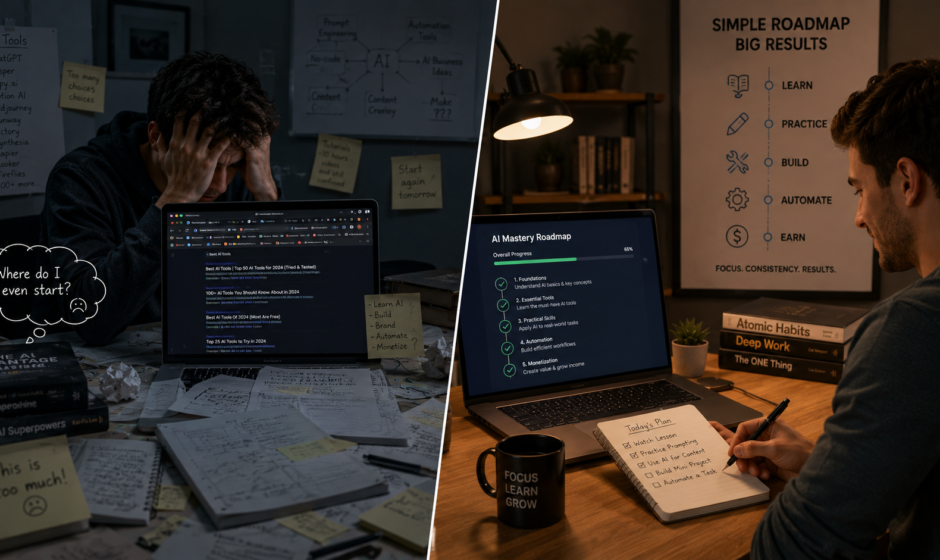

Thousands of people start learning AI every month, but only a few make real progress. Discover why—and how you can avoid the biggest mistakes.
Every January, millions of people make the same promise.
“This is the year I’ll finally learn AI.”
They download free guides.
Watch YouTube tutorials.
Follow AI influencers on social media.
Sign up for newsletters.
Save hundreds of posts they plan to read later.
At first, it feels exciting.
Every day brings another “must-know” AI tool.
Another “game-changing” prompt.
Another “secret” that promises to change everything.
But then…
Weeks turn into months.
The excitement slowly disappears.
The notebook is still full.
The bookmarks keep growing.
Yet nothing meaningful has been built.
If you’ve ever felt that way, you’re not alone.

The Difference Isn’t Intelligence
Here’s something that surprised me.
Some people seem to understand AI almost overnight.
Others spend years consuming information but never feel confident enough to use it.
At first, I thought the difference was talent.
Then I thought maybe they had expensive courses.
Or perhaps they simply had more time.
But after observing successful creators and business owners, I realized something completely different.
The people making progress weren’t necessarily smarter.
They were simply learning differently.

The “Learning Trap” Nobody Warns You About
One of the biggest mistakes beginners make isn’t buying the wrong AI tool.
It’s believing that watching is the same as learning.
You finish another YouTube video.
You tell yourself,
“That was useful.”
You download another PDF.
“I’ll read it later.”
You save another AI prompt.
“I’ll definitely use this someday.”
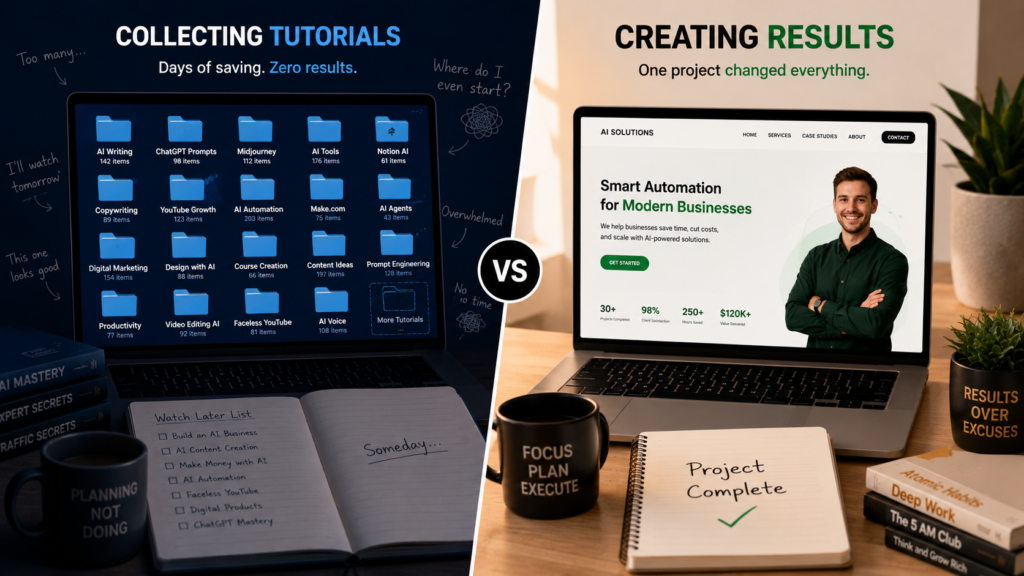
Without realizing it, you’re collecting information instead of building experience.
It feels productive.
But progress isn’t measured by how much content you consume.
Progress is measured by what you actually create.
Knowledge Without Action Creates False Confidence
Psychologists sometimes refer to this as the illusion of competence.
The more information we consume, the more confident we feel.
But confidence built on information alone disappears the moment we have to apply it.
Think about learning to ride a bicycle.
You could read ten books about cycling.
Watch fifty tutorials.
Even memorize every part of the bicycle.
But until you actually ride one…
You haven’t truly learned.
Artificial intelligence works exactly the same way.
Reading about AI doesn’t build experience.
Using AI does.
Why Most People Quit Too Early
Learning AI can feel overwhelming.
Not because it’s too difficult.
But because there’s always something new.
A new chatbot.
A new automation tool.
A new video promising faster results.
Many beginners believe they’re falling behind.
So they jump to the next trend.
And then the next.
Eventually, they become trapped in an endless cycle of starting over.
The problem was never their ability.
The problem was never AI.
The problem was the lack of direction.

The People Who Progress Fast Follow a Different Strategy
Instead of chasing every new AI trend, successful learners simplify their journey.
They choose one roadmap.
One learning path.
One system.
They focus on building skills before collecting tools.
That single decision often saves months of frustration.
If you’re feeling overwhelmed by the endless amount of AI content available online, exploring a structured learning resource like AI Army can help you focus on practical skills instead of constantly wondering what to learn next.
The Fastest Learners Don’t Learn More…
They Learn Better.
Take a moment and think about the people you admire online.
The creators who seem to produce amazing content every week.
The entrepreneurs launching new products.
The freelancers who always seem busy with clients.
Do you think they know every AI tool on the market?
Probably not.
Most of them simply know how to use a few tools exceptionally well.
They’ve stopped chasing every new trend and started building systems that work.
That’s why they continue moving forward while everyone else is still deciding where to begin.

Consistency Will Always Beat Motivation
Motivation is exciting.
It makes us buy books.
Download courses.
Subscribe to newsletters.
But motivation doesn’t last forever.
There will be days when learning feels difficult.
Days when you feel like you’re making no progress.
Days when another influencer convinces you there’s an easier shortcut.
That’s completely normal.
The difference is that successful learners don’t depend on motivation.
They depend on habits.
They schedule time to practice.
They complete small tasks every day.
And over time, those small actions become real skills.
Remember…
No one becomes confident by thinking about AI.
Confidence comes from using it.
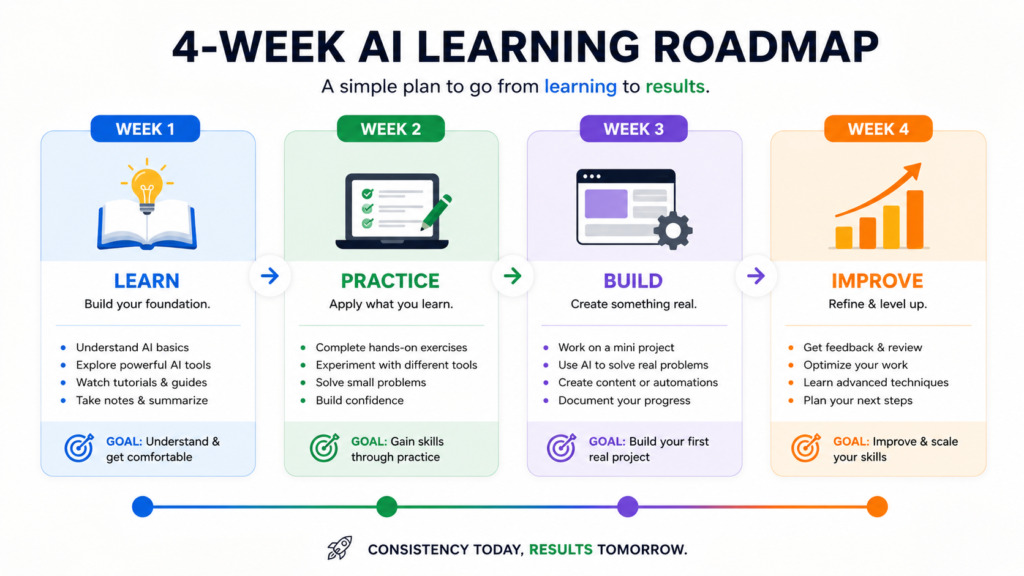
A Simple 30-Day AI Learning Framework
If you’re wondering where to begin, don’t overcomplicate it.
Here’s a simple approach that many successful learners follow.
Week One
Understand the basics.
Learn what AI can actually do.
Don’t worry about mastering everything.
Week Two
Practice using AI for small everyday tasks.
Write.
Research.
Organize ideas.
Experiment.
Week Three
Apply AI to a real project.
Start a blog.
Create content.
Help a friend.
Build something useful.
Week Four
Improve your workflow.
Repeat what works.
Ignore what doesn’t.
By the end of those thirty days, you’ll have something much more valuable than hundreds of bookmarked tutorials.
You’ll have experience.
The Right Roadmap Can Save You Months
One of the biggest advantages of following a structured learning path is that it removes unnecessary guesswork.
Instead of wondering,
“What should I learn next?”
you already know the next step.
That allows you to spend less time searching and more time building.
Many beginners find that having a clear roadmap makes learning less stressful and far more enjoyable.
If you’re looking for a structured resource that brings AI concepts together into one practical learning journey, AI Army is worth exploring as you continue developing your skills.
Final Thoughts
Artificial intelligence is moving faster than almost any technology we’ve seen before.
But don’t let that intimidate you.
You don’t have to know everything.
You don’t have to master every tool.
And you certainly don’t have to compare your journey to people who’ve been doing this for years.
Start where you are.
Learn one skill.
Apply it.
Improve it.
Repeat the process.
A year from now, you’ll be amazed by how much progress those small daily actions can create.
The future belongs to people who keep learning.
Not the ones who keep waiting.
Frequently Asked Questions
Do I need previous experience before learning AI?
Not at all. Many people start with no technical background. The key is choosing a clear learning path and practicing consistently.
How many AI tools should I learn first?
Start with one or two tools you can use confidently. It’s better to master a few tools than to know a little about dozens.
Can AI skills help me outside of work?
Yes. AI can improve productivity, help with personal projects, content creation, learning, research, and many everyday tasks.
How do I avoid feeling overwhelmed?
Focus on one learning goal at a time. Ignore the pressure to keep up with every new AI tool and build experience step by step.
Ready to Stop Watching and Start Building?
Thousands of people spend months consuming AI content without ever applying what they’ve learned.
Don’t let that be your story.
If you’re ready to follow a structured learning path and build practical AI skills with confidence, take the next step and explore AI Army today.